ABSTRACT
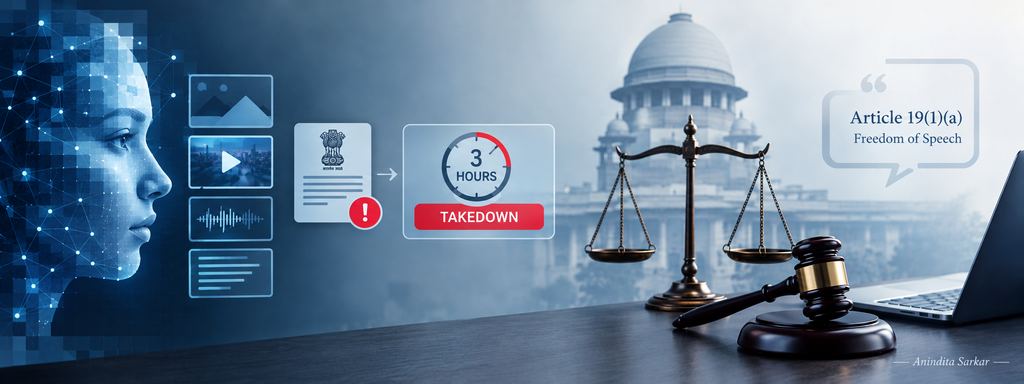
The rapid advancement of Generative Artificial Intelligence (GenAI) has increased the creation and circulation of realistic Synthetically Generated Information (SGI), creating new challenges for intermediary liability. The Information Technology (Intermediary Guideline and Digital Media Ethics Code) Amendment Rules, 2026 introduce a statutory framework for SGI and reduce the timeline under Rule 3(1)(d) for intermediaries to act upon qualifying government or court notification from thirty-six hours to three-hours. This article examines the interacts between the compressed timeline, the conditional safeguard under Section 79 of Information Technology Act, 2000 (IT Act 2000) and the protection of freedom of speech under Article 19(1)(a) of Indian Constitution. It argues that the concern is not the requirement of rapid action itself, but the difficulty of assessing the legal status of flagged content within a compressed period where the consequences of non-compliance may affect the availability of the Section 79 Safeguard. This may encourage precautionary removal, including where synthetically generated content constitutes protected expression. The framework adequately distinguishes synthetic content from unlawful content and argues for calibrated procedural safeguard, including differentiated timeline, authorized notifications, rapid review of wrongful removal and greater transparency, consistent with Article 19(2) and doctrine of proportionality.
Keywords- Generrative Artificial Intelligence (GenAI); Synthetically Generated Information (SGI); Rule 3(1)(d); Section 79; Intermediary Liability; Article 19; Freedom of Speech.
I. INTRODUCTION
The rapid advancement of Generative Artificial Intelligence (GenAI) has changed how information is created and circulated online. AI systems are capable of generating realistic texts, images, audios, videos and codes that closely replicate real persons, events and situations. It gives rise to new challenges for intermediary liability law, particularly where fabricated material is presented as authentic.
Apprehension involving impersonation, non-consensual intimate content sharing, financial fraud and information manipulation has increased, causing the need for rapid regulatory actions. In response, the Ministry of Electronics and Information Technology (MeitY) notified the Information Technology (Intermediary Guidelines and Digital Media Ethics Code) Amendment Rules 2026 (2026 Amendment Rule), on 10th February 2026. The Amendment Rule introduces a statutory definition of Synthetically Generated Information (SGI) and reduces the duration for intermediaries to act upon government direction or judicially flagged unlawful information under Rule(R) 3(1)(d) from thirty-six hours to three hours. The conditional safeguard under Section 79 of the Information Technology Act 2000 (IT Act), the three-hour requirement may encourage removal over careful review.
II. Synthetically Generated Information under the 2026 Framework
II.1. Definition and Subjective Threshold
R 2(1)(wa), inserted by the 2026 Amendment Rules, defines SGI as audio visual material artificially created, generated, modified or altered using a “computer resource” so that it appears real, authentic or true and replicate a person or event in a manner likely to be perceived as undistinguished from a real person or event. The operative word ‘appear’ and ‘likely to be perceived,’ focus on how the material may be perceived by an ordinary viewer rather than on a specific technical or forensic expert. This creates a subjective threshold for identifying SGI.
II.2. Exclusion and Treatment as Information
The Rules exclude routine editing, educational or illustrative material, and accessibility enhancement such as captioning, where these do not misrepresent the underlying content. R 2(1A) treats SGI as information for the purpose of R 3(1)(b), R 3(1)(d), and R 3(2)(a)(i), while R 2(1B) protects an intermediary from loss of safeguard where it removes information, including SGI through reasonable automated measures.
III. The Three-Hour Takedown Rule 3(1)(d)
III.1. The Compressed Timeline
R 3(1)(d) previously required an intermediary to remove or disable access to information within thirty-six hours of receiving actual knowledge, through a court order or an appropriate government notification or its authorized agency, that the material was being used to commit an unlawful act. The 2026 Amendment Rules retain the actual knowledge trigger but compress the response period to three hours for most flagged information, and to two hours for sensitive categories such as non-consensual intimate and child related shared obscene material. Three hours affords significantly less space for a considered legal assessment.
III.2. The Sahyog Trigger
In practice, government notification may arrive through the Sahyog Portal, a coordinator platform operates under Ministry of Home Affairs (MHA) through the Indian Cyber Crime Coordinator Centre (I4C). Officers from central and state agencies can route takedown requests through this channel. Once a qualifying notification reaches the intermediary and constitute actual knowledge, the three-hour clock begins to run under R 3(1)(d). Submissions before the Bombay High Court (HC) describe several takedown requests processed through the portal, including a request to remove a post concerning a Chief Minister’s (CM) foreign visit.
III.3. Operational and Interpretive Strain
Within this window, an intermediary must locate the flagged content, assess whether it genuinely falls within the unlawful category identified in the notification and disable access. This can become more difficult when the content is in a regional language, uploaded at an inconvenient hour, or has already been reshared across multiple accounts by the time notice arrives. Industry representations to the government describe the timeline as difficult to meet without permanently staffed and partly automated compliance teams, a burden that smaller intermediaries are unlikely to absorb as easily as dominant platforms. Where genuine ambiguity exists, for instance, where content may be satire rather than deception, three hour leaves little room for anything beyond a precautionary judgment.
IV. Section 79 Safeguard and the Compliance Linkage
IV.1. Conditional Immunity
Section 79 of the IT Act provides an intermediary with protection from liability for third-party information hosted or transmitted through its platform, subject to compliance with due diligence requirements under the Rules. This protection is conditional. Section 79(3)(b), an intermediary may lose this protection if, after receiving actual knowledge through a court order or a government notification that particular information is being used to commit an unlawful act, it fails to expeditiously remove or disable access to that information. The availability of safeguard therefore depends, in part, on the intermediary’s response to a qualifying notice.
IV.2. The SGI Specific Linkage
The 2026 Amendment Rules sharpen this linkage for synthetic content. R 4(1A) requires significant social media intermediaries, define by the Rule as platforms with more than five million registered users in India, to ask uploaders whether content is synthetically generated and to verify that declaration through reasonable technical measures. Failure to comply, or knowingly permitting unlawful SGI to remain may be treated as non-compliance with due diligence and may expose the platform to loss of safeguard under Section 79 for that content. R 2(1B) offers a partial cushion by confirming that reasonable automated removal will not itself breach the neutrality conditions under Section 79(2). However, this protection supports removal, not retention.
IV.3. The pull towards Precautionary Removal
This asymmetry is structural rather than incidental. An intermediary that removes a doubtful item may face a user complaint. An intermediary that retains one may risks losing its safeguard for the relevant information and possible exposure under the criminal jurisprudence the Rules cross-reference, including the Bharatiya Nagarik Suraksha Sanhita, 2023 (BNSS), Bharatiya Nyaya Sanhita, 2023 (BNS) and the Protection of Children from Sexual Offences Act, 2012 (POCSO). Within a three-hour window, this asymmetry may encourage an intermediary to disable access first and assess the legality of the content afterward, a pattern often described in comparative scholarship as collateral censorship or over-removal.
V. Impact on Freedom of Speech
V.1. Article 19(1)(a) and the Reasonable Restriction under Article 19(2)
Online expression, including expression conveyed through synthetic or altered audio-video means, falls within the right to free speech and expression under Article 19(1)(a) of Indian Constitution. Restrictions on those rights are permissible only on the ground enumerated in Article 19(2), covering matter such as the sovereignty and integrity of India, public order, decency or morality, and defamation, and any restriction must satisfy the requirement of the doctrine of reasonableness and proportionality. A takedown mechanism triggered by how realistic content appears, rather than by an assessment of which specific ground it offends, risks operating as a restriction untethered from the constitutional ground that can justify it.
V.2. Shreya Singhal and the Actual Knowledge Safeguard
The Hon’ble Supreme Court (SC) in Shreya Singhal v. Union of India (UOI) remains the doctrinal anchor in this area, in the context of the then-applicable intermediary Rules. The SC struck down Section 66A and read down Section 79(3)(b), holding that intermediaries need to act upon actual knowledge through a court order or authorized government notification. This prevented intermediaries from becoming private arbiters of lawful speech. The 2026 framework retains this formal trigger, but the three-hour window limits the time available for careful assessment, weakening the safeguard’s practical value.
V.3. Protected Synthetic Expression and the sub judice Challenge
Not every synthetically generated item is unlawful merely because it is synthetic. Political satire, journalistic recreation, or caricature may satisfy the “appears real” threshold under R 2(1)(wa) while remaining protected speech. In X Corp. v. Union of India, the Karnataka HC upheld R 3(1)(d) and the Sahyog mechanism against a constitutional challenge. But, the challenges before Bombay HC by Kunal Kamra and Adv. Haresh Jagtiani involve challenges concerning vague takedown grounds, notice and hearing. These cases show that the constitutional concerns become more significant when the same framework operates within a compressed three-hour timeline.
VI. Critical Analysis and Safeguards
VI.1. Proportionality of the Window
The relevant inquiry should not stop at the fact that content is generated by GenAI but should ask if the specific material falls within a ground Article 19(2) actually permits. A uniform three-hour timeline, applied regardless of the complexity of the underlying legal question, treats a straightforward case of non-consensual shared material and a contested case of political commentary identically, even though the two require different levels of legal assessment. Tiering the timeline to the category of harm asserted, same timeline to every notice, would preserve urgency where it is genuinely needed without applying the same timeline to every judgment.
VI.2. Calibrated Procedural Safeguards
A more proportionate framework might retain urgent timelines for categories such as child obscene material while allowing a longer, still expedited timeline for content whose unlawfulness is contested. Government notices should identify the specific unlawful act alleged and the provision relied upon, allowing the intermediary to assess the information within the timeline rather than treating every government flagged information in the same manner. A rapid review mechanism after removal could allow an intermediary to reconsider content wrongly taken down while preserving the safeguard where the intermediary complied with the applicable timeline.
Transparency regarding flagged removals would further allow courts and researchers to assess the extent to which the three-hour timeline is resulting in over-removal of protected speech.
VII. CONCLUSION
The 2026 Amendment Rules recognize the need for rapid action against harmful SGI, but the three-hour takedown requirement raises concerns where unlawfulness is unclear. The central difficulty is the interaction between the SGI framework, government-flagged information, the compressed timeline under R (3)(d), and the conditional safeguard under Section 79. An intermediary faced with limited time and the risk of losing its safeguard may prefer precautionary removal over careful assessment, particularly where the flagged content may also constitute protected expression.
The framework must therefore distinguish synthetic content and unlawful content. The fact that information appears real or is synthetically generated does not, by itself, make it unlawful or take it outside the protection of Article 19(1)(a). Any restriction must be connected to a ground under Article 19(2) and satisfy the requirement of proportionality. The three-hour timeline should consequently be supported by calibrated procedure safeguards, including specific government notices, differentiated timeline for different categories of harm, rapid review of wrongful removal, and greater transparency regarding government-flagged removals. Such safeguards can preserve rapid action while reducing over-removal and protecting freedom of speech.
THIS ARTICLE IS WRITTEN BY ANINDITA SARKAR, A SECOND-YEAR LL.B. (HONS.) STUDENT AT LAW COLLEGE DURGAPUR, AFFILIATED WITH KAZI NAZRUL UNIVERSITY.
REFERENCE
A. Cases
- Anuradha Bhasin v. Union of India, (2020) 3 SCC 637.
- Avnish Bajaj v. State (NCT of Delhi), 150 (2008) DLT 769.
- Haresh Jagtiani v. Union of India, W.P. (L) No. 4044 of 2026 (Bom. H.C.).
- Kunal Kamra v. Union of India, W.P. (L) No. 4061 of 2026 (Bom. H.C.).
- Modern Dental College & Research Centre v. State of Madhya Pradesh, (2016) 7 SCC 353.
- Om Kumar v. Union of India, (2001) 2 SCC 386, 407–08 (India).
- Shreya Singhal v. Union of India, (2015) 5 SCC 1.
- Union of India v. DigiPub News India Foundation, Transfer Petitions, order dated July 22, 2026 (S.C.).
- X Corp. v. Union of India, W.P. No. 7405 of 2025 (Karnataka H.C. Sept. 24, 2025).
B. Legislation
- Constitution of India arts. 19(1)(a), 19(2).
- Information Technology Act, 2000, §§ 2(1)(w), 69A, 79, 87.
- Bharatiya Nyaya Sanhita, 2023.
- Bharatiya Nagarik Suraksha Sanhita, 2023.
- Protection of Children from Sexual Offences Act, 2012.
- Indecent Representation of Women (Prohibition) Act, 1986.
C. Rules
- Information Technology (Procedure and Safeguards for Blocking for Access of Information by Public) Rules, 2009.
- Information Technology (Intermediaries Guidelines) Rules, 2011.
- Information Technology (Intermediary Guidelines and Digital Media Ethics Code) Rules, 2021.
- Information Technology (Intermediary Guidelines and Digital Media Ethics Code) Amendment Rules, 2025, G.S.R. 775(E) (Oct. 22, 2025) (effective Nov. 15, 2025).
- Information Technology (Intermediary Guidelines and Digital Media Ethics Code) Amendment Rules, 2026, G.S.R. 120(E) (Feb. 10, 2026) (effective Feb. 20, 2026).
D. Government / Official Materials
- MeitY, Gazette Notification, G.S.R. 120(E), Feb. 10, 2026.
- MeitY, FAQs: Amendments to IT Rules 2021 Relating to Synthetically Generated Information (SGI), Feb. 10, 2026.
- MeitY, Corrigendum dated Feb. 26, 2026.
- MeitY, Explanatory Note on Proposed Amendments to IT Rules 2021 Relating to SGI, Oct. 22, 2025.
- PIB, Regulatory Framework Strengthened to Address Harms Arising from Synthetically Generated Information (SGI), Mar. 25, 2026.
- Specific MHA/I4C Sahyog document actually relied upon.
E. Research / Policy
- CIS, Indian Intermediary Liability Regime.
- CIS, Intermediary Liability in India: Chilling Effects on Free Expression on the Internet.
- CIS, Content Takedown and Users’ Rights.
- CIS, Intermediary Liability and Safe Harbour: On Due Diligence and Automated Filtering.
- CIS, The Supreme Court Judgment in Shreya Singhal and What It Does for Intermediary Liability in India?
- Manila Principles on Intermediary Liability.
- U.N. Human Rights Committee, General Comment No. 34.
F. Commentary
MediaNama, How India’s Content Takedown Framework Was Built and Where It Has Gone Wrong (Apr. 27, 2026).
Aayushman Gaikwad & Smruti Mishra, Three Hours To Comply: India’s New Rules For AI-Generated Content And Deepfakes, LiveLaw (Feb. 21, 2026)
Vineet Upadhyay, India’s New 3-Hour Deepfake Removal Rule: Experts Urge Strict Compliance, Indian Express (Feb. 12, 2026; updated Feb. 17, 2026).
MediaNama, Are Platforms Following India’s Deepfake and AI Content Rules? (Apr. 1, 2026).