Dr. Jaya Thakur v. Government of India & Ors., 2026 INSC 97, Writ Petition (Civil) No. 1000 of 2022, Supreme Court of India, decided 30 January 2026 by J.B. Pardiwala and R. Mahadevan, JJ.
Introduction
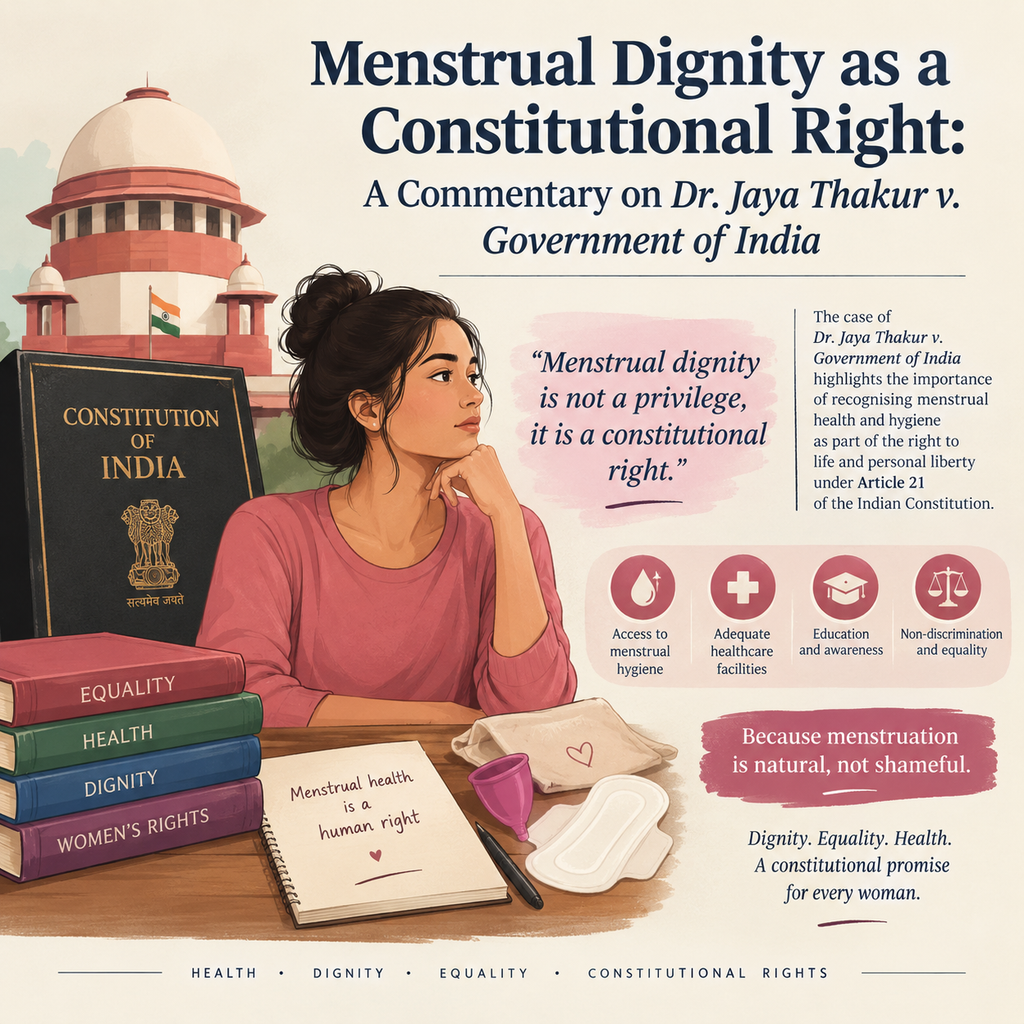
For decades, menstruation in India has been treated as a private matter, managed through welfare schemes and policy documents rather than enforceable rights. On 30 January 2026, the Supreme Court of India changed that framing. In Dr. Jaya Thakur v. Government of India, a Bench of Justices J.B. Pardiwala and R. Mahadevan held that the absence of menstrual hygiene management (MHM) measures in schools offends the rights to equality, dignity and education under Articles 14, 21 and 21A of the Constitution. Commentators have described the decision as the Court’s first concrete, constitutionally rooted, rights-based approach to menstrual health, and as a move of menstrual health “from the realm of welfare schemes and policy initiatives into the domain of enforceable constitutional rights”.
This commentary examines the judgment in six parts: its background, the issues, the governing legal provisions, the Court’s reasoning, its conclusion and directions, and a critical analysis of its strengths and limits.
Background
The petition was filed as a public interest litigation under Article 32. Dr. Jaya Thakur sought a mandamus directing the State to provide free sanitary pads to girls in Classes VI to XII, separate girls’ toilets in government, aided and residential schools, cleaners for those toilets, menstrual health awareness, and safe disposal of menstrual waste. The respondents were the Union of India, the concerned Union Ministries, and the States and Union Territories.
The Court framed the problem as two fold: absenteeism and school drop-outs caused by the lack of MHM measures. It drew on the National Guidelines for Menstrual Hygiene Management and the WHO/UNICEF Joint Monitoring Programme definition of MHM, which together cover awareness, safe materials, water, privacy, soap, and dignified disposal.
It also defined “menstrual poverty” broadly, to include not only the cost of products but inadequate water, sanitation and hygiene (WASH) facilities.
The Union did not deny the problem. It acknowledged that menstruation remains clouded by taboo, that access to sanitary products is limited, and that unhygienic practices harm reproductive health. It placed the Menstrual Hygiene Policy for School Going Girls and a range of schemes before the Court, including Samagra Shiksha, the Swachh Bharat Mission-Gramin and Jan Aushadhi outlets. Many States described their own programmes, but according to one account of the judgment several States and Union Territories filed no affidavits at all. The Court’s key finding was that India has no shortage of policies; what it lacks is consistent implementation.
Research before the Court showed that nearly one-third of adolescent girls in one North Indian study were absent from school during menstruation (29.2% of about 500 students), citing menstrual pain, restrictions at home, fear of staining and difficulty changing pads at school.
Issues Involved
The petition raised four constitutional questions:
Whether the lack of MHM measures violates Article 21A and the Right of Children to Free and Compulsory Education Act, 2009 (RTE Act).
Whether the absence of gender-segregated toilets and menstrual absorbents violates the right to equality under Article 14.
Whether dignified menstrual health forms part of the right to life under Article 21.
Whether the lack of MHM measures violates the right to participate on equal terms and to equality of opportunity under Article 14.
Rules and Legal Provisions
Constitutional provisions. The Court’s analysis rests principally on Articles 14, 21, 21A and 32. It also engages Article 15(3) (special provisions for women and children), and the Directive Principles in Articles 38, 41 and 45, with Article 51 supporting the use of international law.
Statutory provisions. The RTE Act, 2009 is central. Section 3 guarantees free and compulsory elementary education, and the Court read “free” as the removal of financial barriers. Sections 8 and 9 place infrastructure, monitoring and quality duties on governments and local authorities. Section 19 and the Schedule require schools to meet norms and standards, including separate toilets for boys and girl. The Court also referred to Rule 26 of the RTE Rules (child helpline), the Solid Waste Management Rules for disposal, and the logic of the Rights of Persons with Disabilities Act, 2016 for accessibility.
International instruments. The Court invoked Article 26 of the UDHR, Article 13 of the ICESCR, CEDAW, Article 28 of the CRC, and UNESCO materials.
Key precedents. On education as part of life and dignity: Bandhua Mukti Morcha v. Union of India, (1984) 3 SCC 161; Mohini Jain v. State of Karnataka, (1992) 3 SCC 666; Unni Krishnan v. State of A.P., (1993) 1 SCC 645. On substantive equality: Joseph Shine v. Union of India, (2019) 3 SCC 39; Navtej Singh Johar v. Union of India, (2018) 10 SCC 1; Janhit Abhiyan v. Union of India, (2023) 5 SCC 1. On reproductive rights: X v. Principal Secretary, Health and Family Welfare Department, Govt. of NCT of Delhi, (2023) 9 SCC 433. On accessibility and reasonable accommodation: Rajiv Raturi v. Union of India, (2024) 16 SCC 654 and Om Rathod v. Director General of Health Services, 2024 SCC OnLine SC 3130. On quality and “free” education: Society for Unaided Private Schools of Rajasthan v. Union of India, (2012) 6 SCC 1 and Devesh Sharma v. Union of India, (2023) 18 SCC 339. The Court also referred comparatively to Brown v. Board of Education and Plyler v. Doe from the United States.
Reasoning of the Court
Article 14: substantive equality and participation. The Court rejected a formal view of equality. Treating all students identically ignores the position of a menstruating girl shaped by biology and structural disadvantage. Relying on Joseph Shine and Janhit Abhiyan, it held that equality is “expressed through the right to be able to participate on equal terms in community and society”. Without toilets, water, absorbents and disposal facilities, girls cannot compete on equal terms. The Court described the resulting chain of absence, drop-out and exclusion from later life as a domino effect. In this reading, MHM measures are affirmative action required by equality, not charity.
Article 21: dignity, privacy, health and autonomy. The Court held that the right to life includes dignity, privacy, decisional autonomy and reproductive health, and that these are impaired when girls must use unsafe materials, lack clean water, or fear humiliation at school. It held that the right to health includes the “right of a menstruating girl to access MHM practices to attain the highest standard of sexual and reproductive health”. Drawing on X v. Principal Secretary, which tied reproductive rights to access to information, it treated menstrual knowledge as part of bodily autonomy. The State therefore bears a positive obligation to provide safe, effective and affordable MHM measures.
Articles 21A and the RTE Act: quality, barrier-free education. The Court held that quality education includes the conditions that make regular attendance possible. Lack of MHM “disrupts attendance, hinders concentration and consequently, breaks the continuity of schooling”. Barrier-free access is not confined to entering a school building but covers removal of every barrier to a child’s presence in school. Menstrual products can be a financial barrier to “free” education, and the Schedule’s toilet norms are integral to Article 21A, not mere procedure. Failure to meet them is, in the Court’s words as reported, a constitutional failure rather than an administrative one.
Intersectionality and the role of men. Using Rajiv Raturi and Om Rathod, the Court recognised that girls with disabilities face compounded disadvantage and need accessible facilities. It also observed that infrastructure alone is not enough: boys, male teachers and staff must be sensitised, because stigma can make facilities unusable. Menstrual health, the Court said, is a shared responsibility.
No earlier decision was overruled. The Court applied and extended existing doctrine.
Conclusion and Judgment
The Bench delivered a unanimous, joint judgment with no dissent. It held that the lack of MHM measures in schools violates Articles 14, 21 and 21A read with the RTE Act, and it issued binding directions to all States and Union Territories.
Free oxo-biodegradable sanitary napkins, compliant with ASTM D-6954, available to girl students, preferably through vending machines in toilet premises, with Menstrual Hygiene Management corners stocked with spare innerwear, spare uniforms and disposal bags.
Functional, gender-segregated toilets with water in every school, government or private, urban or rural, accessible to children with disabilities, with handwashing facilities and soap available at all times.
A safe disposal mechanism under the Solid Waste Management Rules, with covered bins in each toilet unit.
Gender-responsive curricula on menstruation, puberty and related health concerns such as PCOS and PCOD, developed by NCERT and SCERT, and training and sensitisation of all teachers.
Wide publicity of the Jan Aushadhi Suvidha napkin scheme and the child helpline under Rule 26 of the RTE Rules.
Periodic inspection, preferably annual, by District Education Officers of toilets, washing facilities, absorbent availability and disposal arrangements.
A continuing mandamus on the Union to ensure compliance.
My Analysis
What the judgment gets right. First, it grounds menstrual health in doctrine rather than sentiment. By joining Articles 14, 21 and 21A, it avoids resting the right on a single provision that might later be narrowed. Second, the choice of substantive equality is persuasive: it explains why a school that is formally open to all can still be functionally closed to menstruating girls. Third, the directions are concrete and verifiable (toilets, water, soap, pads, bins, inspections), which makes non-compliance measurable. Fourth, the Court recognised that stigma is itself a barrier, and brought boys, male teachers and curricula into the remedy. Finally, applying the directions to private as well as government schools means a child’s rights do not depend on who runs her school.
Doctrinal tension on age. Article 21A guarantees education for children aged six to fourteen, yet the petition and directions concern girls in Classes VI to XII. For older girls the justification must come from Articles 14 and 21 rather than 21A and the RTE Act. The reports I reviewed do not show how the Court handles this overlap, and a full reading of the judgment on this point would strengthen any critique.
Implementation is the real test. The Court itself found that policies exist but are unevenly implemented. Directions that require toilets, water, free pads and disposal in every school carry significant fiscal and administrative costs for States, and commentators have already begun to ask whether recognition of the right will be matched by resources. The annual District Education Officer inspection and the continuing mandamus are the Court’s answer, but they depend on reporting and follow-up. Public dashboards, dedicated budget lines, grievance mechanisms and independent audits would make compliance more reliable. This is my suggestion rather than a direction of the Court.
A point for further scrutiny. The direction to supply oxo-biodegradable napkins reflects an environmental choice. Oxo-degradable plastics have been contested internationally on environmental grounds, so the choice of material and its fit with the Solid Waste Management Rules may need examination. I raise this as a question to verify against the judgment’s reasoning, not as a settled criticism.
Broader significance. The judgment strengthens a line of cases in which the Court has insisted that rights be usable in practice, and its reasoning on barrier-free education may extend to other school conditions such as disability access, safety and nutrition. As “Dignity, Equality, and Menstrual Health: A Constitutional Moment for India,” observes, treating menstrual health infrastructure as essential public health investment rather than auxiliary welfare spending places real responsibility on Union and State governments. Whether the judgment is remembered as a watershed will depend less on its language than on what happens in school toilets across India over the next few years.
THIS CASE SUMMARY IS WRITTEN BY KAVYANJALI B S FROM ST. JOSEPH’S COLLEGE OF LAW
REFERENCES
- Dr. Jaya Thakur v. Government of India & Ors., 2026 INSC 97, Writ Petition (Civil) No. 1000 of 2022 (Supreme Court of India, 30 Jan. 2026). Official judgment PDF (https://api.sci.gov.in/supremecourt/2022/35023/35023_2022_7_1502_68117_Judgement_30-Jan-2026.pdf)
- Jaya Dubey, “Dr. Jaya Thakur v. Government of India & Ors., 2026 INSC 97,” LawFoyer, 26 Aug. 2026, https://lawfoyer.in/dr-jaya-thakur-v-government-of-india-ors-2026-insc-97/
- Seerat Gill, “The Good, the Bad and the In-Between: Analysing the Supreme Court Judgment on Menstrual Health,” RGNUL Student Research Review, 1 May 2026, https://www.rsrr.in/post/the-good-the-bad-and-the-in-between-analysing-the-supreme-court-judgment-on-menstrual-health
- “Dignity, Equality, and Menstrual Health: A Constitutional Moment for India,” Health and Human Rights Journal, 12 Feb. 2026, https://www.hhrjournal.org/2026/02/12/dignity-equality-and-menstrual-health-a-constitutional-moment-for-india/
- Kavya Agrawal and Stuti Agrawal, “From Rights Recognition to Resource Deficit: Implementation Realities After Dr. Jaya Thakur v. Union of India,” LiveLaw, https://www.livelaw.in/lawschool/articles/rights-recognition-resource-deficit-menstrual-health-523516
Cases and instruments cited
Rights of Persons with Disabilities Act, 2016; Solid Waste Management Rules.
Bandhua Mukti Morcha v. Union of India, (1984) 3 SCC 161.
Mohini Jain v. State of Karnataka, (1992) 3 SCC 666.
Unni Krishnan, J.P. v. State of A.P., (1993) 1 SCC 645.
Navtej Singh Johar v. Union of India, (2018) 10 SCC 1.
Joseph Shine v. Union of India, (2019) 3 SCC 39.
Indian Young Lawyers Association v. State of Kerala, (2019) 11 SCC 1.
Society for Unaided Private Schools of Rajasthan v. Union of India, (2012) 6 SCC 1.
Janhit Abhiyan v. Union of India, (2023) 5 SCC 1.
X v. Principal Secretary, Health and Family Welfare Department, Govt. of NCT of Delhi, (2023) 9 SCC 433.
Devesh Sharma v. Union of India, (2023) 18 SCC 339.
Rajiv Raturi v. Union of India, (2024) 16 SCC 654.
Om Rathod v. Director General of Health Services, 2024 SCC OnLine SC 3130.
Constitution of India, Arts. 14, 15(3), 21, 21A, 32, 38, 41, 45, 51.
Right of Children to Free and Compulsory Education Act, 2009, ss. 3, 8, 9, 19 and Schedule; RTE Rules, r. 26.