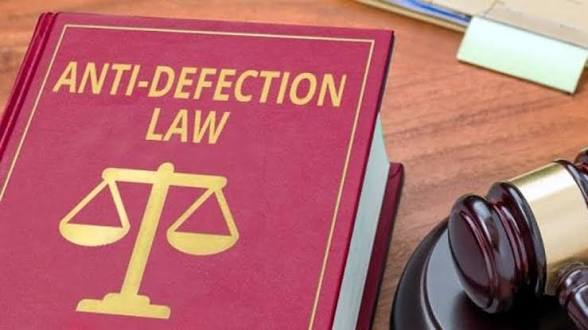
Recently two striking episodes of political realignment where 7 out of 10 MPs of the Rajya Sabah crossing over to from AAP to BJP and two months later 20 Rebel MPs of the TMC announcing the merger with NCPI. In both cases defectors are citing Paragraph 4, “the Merger Exception” to justify the political realignment.
Background of the Tenth Schedule
A mocking nick name was given to practice of Anti-Defection after Haryana MLA Gaya Lal switched parties in a single day in 1967. Following the scrutiny the Government constituted a Committee on defection under Home Minister Y.B. Chavan. The committee submitted that roughly 542 cases have been registered between the First and the Fourth General elections and roughly 438 defections took place between 1967-68 alone. Moreover, these defections were largely attributed to the lure of office as out of 210 defections covering several states, 116 were included in the Council of Ministers. Even after the committee report, it took a further sixteen years of unchecked defection before Parliament finally acted and 52nd Constitutional Amendment Act, 1985 was passed, inserting the Tenth Schedule into the Constitution. The immediate effect of the Tenth Schedule was reduction in instances of defection.
However, the law itself recognised certain political realignments to be legitimate, which eventually became a new catalyst for the defectors. The split exception to avoid disqualification provided by Paragraph 3 of the Tenth Schedule was available where, if at least 1/3rd of the members of the legislature part formed a separate group. Also, Paragraph 4 allowed merger of parties, provided that at least 2/3rd of the members of the legislature party agreed to the merger. Survey tells us that between the period of 1986 to2004, out of 55 separate defection matters only 6 resulted in disqualification. Many times, the very same group of legislators invoked both paragraph 3 and 4 in quick succession: first using the “split” to break away from the original party they were part of and then using “merger” to join the party they always intended to. Defections in Janta Dal in the 1990s provide a clear illustration of how the provisions facilitated large scale of realignment. In 1991 Usha Sinha and 29 others and Chandra Shekhar and 24 others who claimed one third split exception were not disqualified, in the same year VC Shukla and 6 others also relied on the same provision but were disqualified. Similarly in 1994 Janata Dal, Chandrajeet Yadav and 13 others, and in 1997, Ajit Kumar Mehta and 15 others, used the split exception.
By early the 2000s, the pattern became impossible to ignore and after much deliberation the “split” exception given by Paragraph 3 was omitted by 91st Constitutional Amendment Act, 2003. Also the amendment capped the Council of Ministers at 15% of a House’s total strength, closing the office incentive driven defections. However, paragraph 4 remained fully intact, allowing defectors to use only one legitimate route for political realignment.
Paragraphs of the Tenth Schedule in discussion
To understand why the merger exception underpins the article’s argument, it is fundamental to understand the precise text of the Tenth Schedule itself.
Paragraph 2 sets out two grounds for disqualification: a member who voluntarily abandons their party affiliation, and a member who votes or abstains against their party’s whip without securing permission beforehand — though this second ground falls away if the party itself forgives the vote within fifteen days.
Paragraph 4 gives the merger exception itself, a member is shielded from disqualification where their original party merges with another, provided “not less than two-thirds” of the legislature party agree.
Political party v. Legislature party
After careful reading of Paragraph 4 the two terms “legislature party” and “political party” are highlighted. Paragraph 1(b) defines a “legislature party” is simply the group of a party’s own members sitting in a given House.
Under Paragraph 1(c), the “original political party” is the party to which a member is bound for disqualification purposes under Paragraph 2(1), the organisation whose ticket the member actually stood on.
In the case of Subhash Desai vs Principal Secretary, Governor Of Maharashtra & Ors. the Apex Court stated that ‘Political party’ and ‘legislature party’ are separate entities. The Tenth Schedule acknowledges the later only as available to legislators against disqualification and not as an independent existing political entity.
A related principle emerged from an earlier case, Rajendra Singh v. Swami Prasad Maurya (2007): the Supreme Court refused to accept that legislators’ conduct alone could establish a split, insisting instead on proof of two separate things happening together, a real division inside the party organisation, and a matching split among its elected members.
Applied to Paragraph 4, this reasoning cuts against any merger claim resting purely on numbers. A merger, no less than a split, has to be something the party itself does and not something a sufficiently large group of legislators can bring about simply by agreeing among themselves.
The loophole: the merger exception
The data of Vidhi Centre’s survey of Lok Sabha defections showed that between 1986 to 2004 the merger claims had always been upheld. Even in post 91st amendment, this pattern continues, as illustrated by 2019 in Goa episode where exactly the two thirds of the party’s legislatures in the State Assembly merged with BJP. The Goa Speaker ruled that the merger is valid. Also, in 2026 the Rajya Sabha 7 out 10 MPs of AAP announced merger with the BJP. It must be noted in many of these cases the newly defected members like Swati Maliwal of the Rajya Sabha was a vocal critique of the BJP and its members. This produces a question of a genuine realignment or personal beneficial factor giving way to defection. Nothing in Paragraph 4 relates to value or genuine ideological realignment.
Further, even if it is to be seen that the merger is not valid and the members may be disqualified, another route they can take is the route of resignation before the process of disqualification is completed which is further helped by the fact that there is no deadline for the Speaker of the House for deciding on the disqualification. They can simply resign and return to Assembly through by-elections. At the same time even if the member is disqualified under the tenth schedule, such a member is not barred from contesting elections again, as affirmed by Shrimanth Balasaheb Patil and Ors. Vs. Hon’ble Speaker, Karnataka Legislative Assembly and Ors.
Party Alliances
The Tenth Schedule’s blind spots extend beyond just party splits and mergers. They also apply to alliances that change after elections. In a multi-party democracy, coalition governments have led to shifts in both pre-poll and post-poll alliances. However, the Tenth Schedule does not address these realignments. For example, the fragmentation of Janta Dal in the 1990s has continued into 2026. The I.N.D.I.A. Bloc, made up of major opposition parties against the BJP, has seen members from AAP, Shiv Sena (UBT), and TMC change alliances or join the BJP-led NDA.
The Voters and Political Parties
A political party’s role extends well beyond the legislature itself. Parties mobilise voters, shape public debate through manifestos and campaign messaging, and build an ideological identity long before a single vote is cast. A citizen’s ballot is, in that sense, a response to all of this and sometimes genuine endorsement of a party’s platform or a deliberate vote against a rival rather than enthusiasm for the winner.
Either way, the vote reflects a choice about which party, not merely which individual, should represent that constituency. When a legislator abandons that party mid-term, the choice voters actually made is quietly overridden, which is why defection, whatever legal form it takes, ultimately functions as a betrayal of the electorate’s trust rather than a purely internal party matter.
Possible Solutions
The question ahead is what a workable framework for anti-defection may look like to cover the grey areas and loopholes so that the principles of the Parliamentary democracy can flourish.
On the legal tests, above arguments relating to Subhash Desai case established that party’s numbers cannot substitute for a genuine merger of political parties. An explicit amendment to the texts of the Paragraph 4 itself, stating the legislature party itself is not sufficient and the original party’s own merger is required. This would remove the ambiguity in the procedural mechanism of mergers.
Further, 170th report of the Law Commission of India recommended merger provision to extent to pre-election front/coalition of political parties and these coalition should be treated as a “political party” .
Moreover, the report also suggested tightening or removing the merger exception outright, on the ground that any defence permitting group defection, however framed, undermines the law’s central purpose
In Keisham Meghachandra Singh v. Speaker, Manipur legislative assembly held that the Speaker of the Legislative Assembly should decide on a petition seeking disqualification of a member under Tenth Schedule of the Constitution within a period of three months from the date on which petition is filed.
Another change that can occur is consequence of defection is disqualification and it has long been argued that for the 10th Schedule to act as an effective deterrent the disqualification should extend to the entire election cycle of 5 years and a ban on contesting by-elections.
On who decides: both the Dinesh Goswami Committee and the National Commission to Review the Working of the Constitution (2002) independently reached the same conclusion, that at disqualification questions should not rest with the Speaker or Chairman at all, but should instead vest in the Election Commission of India, removing the decision from an office that is, by definition, a member of a political party.
The 2002 commission recommended that the provisions of the Tenth Schedule of the Constitution should be amended specifically to provide that all persons defecting, from the party or the alliance of parties, on whose ticket they had been elected, must resign from their parliamentary or Assembly seats and must contest fresh elections.
The defectors should also be debarred to hold any public office of a minister or any other remunerative political post for at least the duration of the remaining term of the existing legislature or until, the next fresh elections whichever is earlier.
The vote cast by a defector to topple a government should be treated as invalid. Further, the power to decide questions as to disqualification on ground of defection should vest in the Election Commission instead of in the Chairman or Speaker of the House concerned.
In Keisham Meghachandra Singh v. Speaker, Manipur (2020) the Supreme Court itself suggested thatthe Parliament should consider creating a permanent independent tribunal, a retired Supreme Court judge or a retired High Court Chief Justice, to hear defection matters exclusively.
Further, the Judiciary can also take suo-motu in cases where the Speaker of the house has delayed the motion for more than 3 months from the date of filing.
THIS ARTICLE IS WRITTEN BY MOHIT VERMA FROM NEW LAW COLLEGE , BHARATI VIDYAPEETH (DEEMED TO BE UNIVERSITY)
REFERENCES :
Bhardwaj, A. (July 4, 2019). Return of Aaya Ram, Gaya Ram: How the anti-defection law is misinterpreted. Business Standard. https://www.business-standard.com/article/politics/return-of-aaya-ram-gaya-ram-how-the-anti-defection-law-is misinterpreted-119070300387_1.html
Ministry of Home Affairs, Government of India, Report of the Committee on Defections (1969).
The Constitution (Fifty-second Amendment) Act, 1985.
Ritwika Sharma & Mayuri Gupta, Anatomy of India’s Anti-Defection Law, Vidhi Ctr. for Legal Pol’y (Nov. 2023), https://vidhilegalpolicy.in/research/anatomy-of-indias-anti-defection-law/.
The Constitution (Ninety-First Amendement) Act, 2003.
India Const. sch. 10, ¶ 2.
Subhash Desai v. Principal Secretary, Governor of Maharashtra, 2023 SCC OnLine SC 607 (India).
Rajendra Singh v. Swami Prasad Maurya, (2007) 4 SCC 270 (India)
Ritwika Sharma & Mayuri Gupta, Anatomy of India’s Anti-Defection Law, Vidhi Ctr. for Legal Pol’y (Nov. 2023), https://vidhilegalpolicy.in/research/anatomy-of-indias-anti-defection-law/.
Shrimanth Balasaheb Patil v. Speaker, Karnataka Legislative Assembly, (2020) 2 SCC 595 (India).
Subhash Desai v. Principal Secretary, Governor of Maharashtra, 2023 SCC OnLine SC 607 (India).
Law Commission of India, Reform of the Electoral Laws, Report No. 170.
National Commission to Review the Working of the Constitution, Report (2002).
Keiham Meghachandra Singh v. Speaker, Manipur Legislative Assembly, (2020) 19 SCC 776 (India).