If you have been following legal news in India, you have heard about BNS, BNSS, and BSA. But what exactly are these laws? How do they affect you as a citizen? And what do law students need to know for their exams?
This article answers all of that in plain language.
The Big Picture: Three Old Laws Replaced by Three New Ones
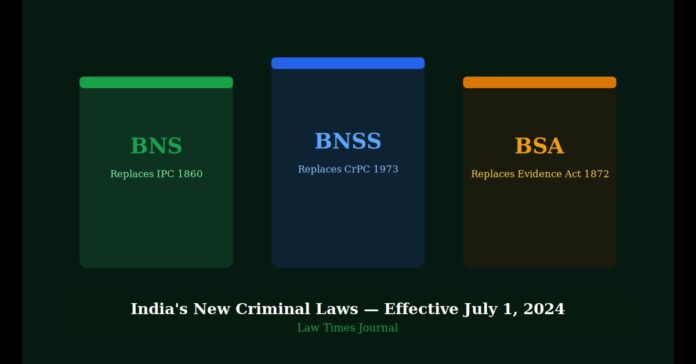
On July 1, 2024, India replaced three colonial-era criminal laws that had governed the country for over 160 years:
| Old Law | Replaced By | What It Covers |
| Indian Penal Code, 1860 (IPC) | Bharatiya Nyaya Sanhita, 2023 (BNS) | What is a crime and what is the punishment |
| Code of Criminal Procedure, 1973 (CrPC) | Bharatiya Nagarik Suraksha Sanhita, 2023 (BNSS) | How a crime is investigated and tried |
| Indian Evidence Act, 1872 (IEA) | Bharatiya Sakshya Adhiniyam, 2023 (BSA) | What counts as proof in court |
These are not amendments. They are entirely new laws replacing the old framework root and branch.
Why Were the Old Laws Replaced?
The IPC was written in 1860 by British colonial administrators to govern — and control — Indians. The CrPC and Evidence Act followed the same colonial philosophy: punishment-first, citizen-last.
Specific problems included:
- Outdated language (references to telegrams, horse-drawn carriages, colonial-era institutions)
- No recognition of digital evidence, electronic records, or cyber crime
- No fixed timelines for investigation or trial — cases dragged on for years or decades
- Provisions that were designed to suppress dissent rather than deliver justice
The new laws aim to fix these problems with a “citizen-first” approach.
BNS: The New IPC — What Crimes Have Changed?
The BNS has 358 sections compared to the IPC’s 511 — leaner but more comprehensive.
New Offences Added:
- Organised Crime — now explicitly defined, including economic offences as organised crime
- Terrorism — for the first time, terrorism is defined in the main criminal law (earlier only in UAPA)
- Mob Lynching — specific provision against murder or grievous hurt by a group of 5 or more
- Snatching — a separate new offence
- Sexual intercourse by deceitful means — new offence
Key Changes:
- Community service introduced as punishment for 6 minor offences — India’s first
- Mandatory minimum punishment now specified for 23 offences
- Punishment increased for 33 offences
- Sedition removed — but replaced with Section 152 BNS which criminalises “acts endangering sovereignty, unity and integrity of India” — critics argue this is sedition by another name
Section Number Changes (Important for Exams):
| Old IPC Section | Offence | New BNS Section |
| 302 | Murder | 103 |
| 376 | Rape | 63 |
| 420 | Cheating | 318 |
| 498A | Cruelty by husband | 85 |
| 307 | Attempt to murder | 109 |
| 379 | Theft | 303 |
Law students note: Court proceedings and FIRs filed before July 1, 2024 continue under IPC. New FIRs from July 1, 2024 use BNS sections.
BNSS: The New CrPC — How Has Procedure Changed?
The BNSS has 531 sections (up from CrPC’s 484) and introduces major procedural reforms.
Most Important Changes:
1. Zero FIR You can now file an FIR at any police station regardless of where the crime occurred. The police must register it and transfer it to the correct jurisdiction. This was informally practised earlier but is now a legal right under Section 173(1) BNSS.
2. Forensic Investigation Made Mandatory For offences punishable by 7 years or more, forensic team visits to the crime scene are now mandatory. This significantly improves investigation quality.
3. Electronic Summons Summons can now be served electronically — by email, WhatsApp, or other digital means. This reduces delays drastically.
4. Police Custody Extended Police custody has been increased from 15 days to up to 90 days for serious offences (in instalments). This is one of the most controversial changes — civil liberties groups have raised serious concerns.
5. Fixed Timelines
- Rape medical examination: within 7 days
- Framing of charges: within 60 days of first hearing
- Judgement: within 30 days of completion of arguments
- Adjournments limited to maximum 2
6. Trial in Absentia If a proclaimed offender absconds to avoid trial, judgement can now be pronounced in their absence.
7. Preliminary Inquiry Before FIR For offences punishable by 3–7 years, police can conduct a preliminary inquiry (up to 14 days) before registering an FIR. Critics say this can be misused to delay justice.
BSA: The New Evidence Act — Digital Evidence Gets Primary Status
The BSA modernises India’s law of evidence for the digital age.
Key Changes:
1. Electronic Records as Primary Evidence Under the old Evidence Act, electronic records were secondary evidence and required certification. Under BSA, electronic records including emails, WhatsApp messages, CCTV footage, and metadata are primary evidence.
2. Expanded Secondary Documents The list of secondary documents now includes testimony of a person skilled in examining documents.
3. Voice Samples Courts can now order voice samples from accused persons — not just fingerprints and handwriting as under the old law.
4. Joint Trial Provisions Improved provisions for joint trials in connected offences.
What Does This Mean for You as a Citizen?
Good changes:
- Zero FIR means you can complain at any police station
- Fixed timelines mean faster trials (in theory)
- Digital evidence rules protect your rights in cyber crime cases
- Forensic investigation improves quality of evidence
Concerning changes:
- Extended police custody (up to 90 days) increases risk of custodial abuse
- Preliminary inquiry before FIR can delay registration of complaints
- Property can be attached before guilt is proved
- The sedition-equivalent provision in Section 152 BNS
For Law Students: What to Study
For CLAT 2027:
- Understand the basic purpose of each new law
- Know which law replaced which old law
- Key new offences: organised crime, mob lynching, terrorism definition
- The concept of Zero FIR
For Judiciary Exams (PCS J):
- Section-wise comparison between old and new laws
- New timelines under BNSS
- Digital evidence provisions under BSA
- Controversial provisions and Supreme Court interpretation (watch for new judgements)
For Law School Exams:
- Constitutional validity questions — several provisions challenged in High Courts
- Human rights angle: police custody extension vs Article 21
- Comparative criminal law: how does India’s approach compare to UK/US
Quick Reference: Key Numbers
| Fact | Number |
| BNS sections | 358 |
| BNSS sections | 531 |
| New offences added in BNS | 20 |
| Offences with increased punishment | 33 |
| Offences with community service | 6 |
| Maximum police custody under BNSS | 90 days |
| Maximum adjournments allowed | 2 |
| Date new laws came into force | July 1, 2024 |
Conclusion
The BNS, BNSS, and BSA represent the most significant overhaul of India’s criminal justice system since independence. Whether they will deliver faster, fairer justice — or simply replace colonial tools with new ones — remains to be seen as courts interpret these laws case by case.
What is certain is that every law student, advocate, and informed citizen needs to understand these laws. The IPC, CrPC, and Evidence Act are history. The BNS, BNSS, and BSA are the present.
Law Times Journal covers new laws, Supreme Court judgements, and legal developments every week. Bookmark us and stay informed.
This article is for educational purposes only and does not constitute legal advice.